Projects
Fushun advances construction of combined compressed-air and flywheel storage project
Fushun’s planned hybrid project combines 100 MW/400 MWh of adiabatic compressed-air storage with a 10 MW flywheel, pairing longer-duration storage with fast frequency response.
During a May 13 visit to the Liaoshui Xinneng Fushun 100 MW / 400 MWh compressed-air-plus-flywheel storage construction site in Xinbin Town, Xinbin Manchu Autonomous County, reporters saw drilling and excavation progressing inside the underground reservoir's connecting tunnel. Workers monitored rotating drilling equipment and rock removal as they prepared the foundations for the combined storage project.
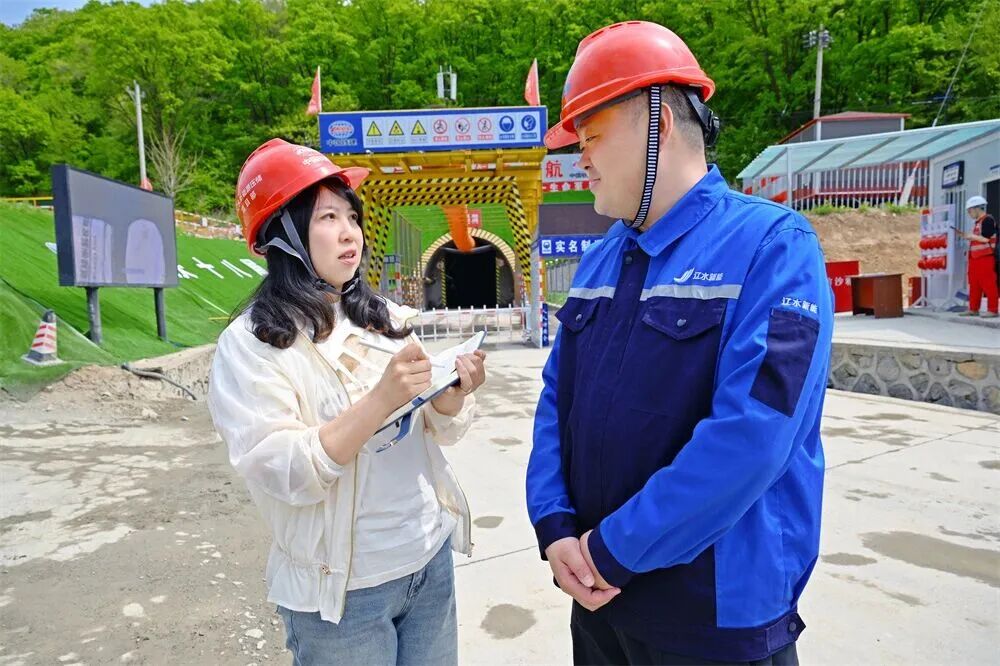
Li Xiaohan, deputy general manager of Liaoning Water Resources Group's renewable-energy development company, described the underground air reservoir as the project's key component and the country's first to use an artificial cavern associated with hydraulic-engineering infrastructure. He highlighted the technical and construction challenges, pointing to the design's ring-arranged, large-section caverns and engineering milestones.
The project is among Liaoning's first new-type-storage pilot demonstrations under its 14th Five-Year Plan. Total investment is RMB 914 million. Plans include 100 MW / 400 MWh of compressed-air storage, a 10 MW flywheel system and a new 220 kV substation. The developer describes it as China's first combined compressed-air and flywheel storage application, pairing long-duration storage with fast frequency response. The compressed-air system uses advanced adiabatic technology without supplementary combustion, with specified electricity-to-electricity efficiency of at least 67.8% at rated conditions and four hours of full-power generation. The flywheel system is designed to respond to primary-frequency-control requirements within 50 milliseconds.
Li said the air reservoir uses new artificial caverns connected to an existing water-conveyance project's branch tunnel, with total volume of at least 116,900 m³ and maximum air pressure of 12 MPa. This reuses the group's hydraulic resources and reduces investment. He said equipment procurement is entirely domestic and the operating process produces no carbon emissions, positioning the project as a stabilising and flexible resource for Liaoning's grid.
Ren Zhichen, manager of Liaoshui Xinneng Fushun Clean Energy, said substantive underground-reservoir construction had begun. Construction-support works, camps, tunnel-entrance facilities, water, ventilation and electricity systems were in place. Construction power had been accepted and energised, the survey-control network completed, and connecting-tunnel excavation and support had reached a cumulative 110 metres.
Ren described caverns with excavation sections nearly 17 metres in diameter, 12,000 metres of steel-lining welds to Class I standards and more than 60,000 m³ of concrete. Precision blasting methods are being used to improve profiles and reduce disturbance to surrounding rock. Safety measures include full video coverage underground, continuous hazardous-gas monitoring and facial-recognition access control. Construction wastewater is treated through three-stage settlement, flocculation and neutralisation and reused, with no discharge.
Under the 2026 construction plan, the underground works targeted 267 metres of connecting-tunnel excavation and support by July 4 and a cumulative 381 metres by December 31. The above-ground EPC contractor was scheduled to enter the site by May 31, begin site grading on July 10 and complete test piles for the main powerhouse and cold- and heat-storage spherical-tank areas by December 30.
The overall construction period is 32 months. All main works are planned for completion by June 30, 2028, followed by integrated commissioning and trial operation by August 25, 2028. Expected annual generation is 120 million kWh. The project is intended to improve peak shaving, frequency regulation, flexibility and renewable-integration security in Liaoning and support related equipment-manufacturing and engineering industries.
The report closes by describing continuing work on a combined, efficient storage facility intended to support a new power system and low-carbon energy development in Liaoning.