Projects
Xinyu quarry-restoration project combines 14 MW of PV with cliff-side ecological rehabilitation
The November 19, 2026 account describes Xinyu's closed-mine restoration work and a 14 MW PV project including about 2.5 MW on cliff faces. It reports 400 mu of restored vegetation and annual generation of about 14 million kWh; the city's 64 closed mines are not 64 separate 14 MW plants.
In recent years, Xinyu has cumulatively closed 64 non-coal mines. Some historically closed mines have left ecological problems such as high, steep slopes, pit spoil deposits and damaged vegetation. To address difficulties including unstable restoration outcomes, weak subsequent maintenance and gaps in responsibility after handover, Xinyu has adhered to a management approach of ‘never simply closing a mine and leaving it, never simply accepting the work and leaving it, and never simply handing it over and leaving it’, focusing on resolving prominent ecological-restoration problems at closed mines.
Xinyu has prepared a ‘one mine, one strategy’ management plan for each mine, reinforcing enterprises' primary responsibilities, local management responsibilities and industry oversight responsibilities. Treatment funding for ownerless mines is coordinated through public finances. It has improved a maintenance system combining ‘engineering construction, subsequent maintenance and regular reinspection’, clarified maintenance responsibilities among natural-resources departments, townships and village collectives, and connected the entire chain of ‘mine closure—engineering treatment—completion acceptance—ownership handover—long-term maintenance’, ensuring continuity of treatment and effective implementation of responsibilities. Using the Jinqiu and Zhecun quarries in Xiannü Lake District as demonstrations, it is actively exploring an integrated ‘ecological restoration plus PV’ approach, turning abandoned pits into ‘sunshine green valleys’ and developing a replicable, scalable model for restoring abandoned mines with high, steep rock faces in southern China.
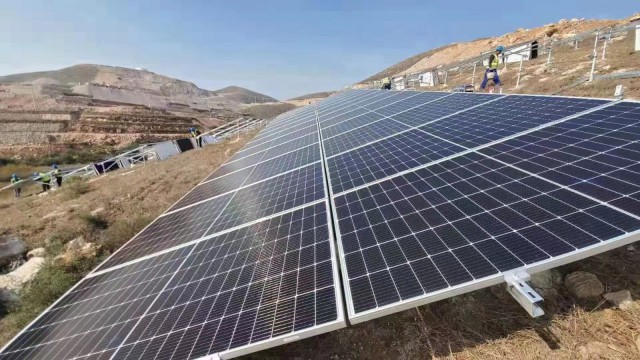
Technical implementation follows a ‘one slope, one strategy’ approach: high, steep rock faces receive a complete restoration process including removal of unstable rock, mesh anchoring and thick-layer substrate spray seeding; soil slopes are covered with coir mats and seeded with mixtures of native shrubs and grasses; and vines and pine seedlings are planted at slope crests and toes to form a three-dimensional revegetation system. At the same time, an innovative anchor-bolt-and-rib-column method is used to install cliff-face PV. The project has a total installed capacity of 14 MW, including approximately 2.5 MW of cliff-face PV, together with an integrated irrigation and drainage system for ‘interception, drainage, storage and spraying’ that effectively improves vegetation survival. In financing, private capital invested RMB 76 million in PV facilities, while public finances coordinated RMB 20.65 million for ecological revegetation. Earth and rock generated by treatment were disposed of publicly, and all RMB 5.33 million in proceeds was returned to ecological-restoration funding. The project strictly observes spatial-control boundaries, occupying no permanent basic farmland and crossing no ecological-protection red lines. It has cumulatively restored vegetation on 400 mu and established a three-year maintenance period to consolidate the restoration results.
The mine area's formerly grey-white rock faces have now become an ecological landscape combining green vegetation and blue PV, and geological-hazard risks have been completely eliminated. The PV plant generates approximately 14 million kWh annually, with annual output value of about RMB 4.9 million. Through land transfers and nearby employment, it also helps surrounding residents steadily increase their income. Using ecological restoration of closed mines as a starting point, Xinyu continues to expand integrated models combining ‘ecological restoration, cultural tourism, land reclamation and specialised agriculture’. It has been recognised as a provincial model case of territorial ecological restoration for four consecutive years, and the Jinshishan mine-restoration project has been selected as a national model ecological-restoration case.