Manufacturer system-architecture article
Trina’s integrated solar-storage approach: AC/DC coupling, controls and lifecycle services
A September 2024 technical article explains Trina's approach to coupled systems, battery enclosures, BMS/PCS/EMS coordination and maintenance.
September 2024 manufacturer architecture briefing. Project status and capabilities refer to that reporting period, not current operating status. This is not project-specific engineering approval or proof of equipment interoperability.
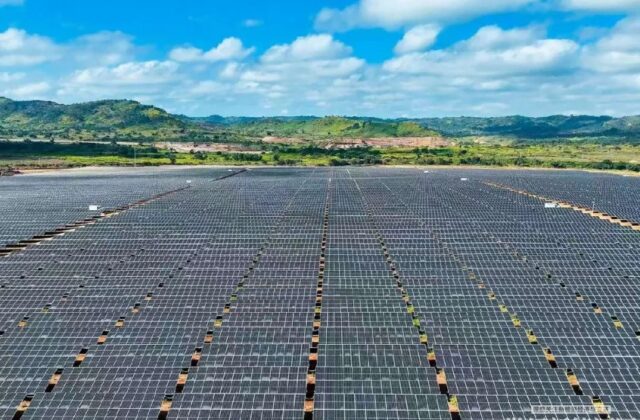
The report describes several Trina Storage developments: a 75 MW / 150 MWh PV-associated storage project in Qinzhou, Guangxi, recently connected to the grid; a 120 MW / 240 MWh agricultural solar-storage solution delivered in Hanting, Shandong, during the reporting year; and full operation in the first quarter of the Linze Tianhai shared-storage station in Banqiao Town, Linze County, Zhangye, Gansu. Trina supplied the second phase's 80 MW / 320 MWh solution, from cells and battery containers through AC-side system integration.
As PV and wind become more important in the energy mix, integrating solar and storage can address intermittency and instability. Trina says its flexible battery-container design supports both AC- and DC-coupled grid-connection solutions across different applications, improving PV utilisation and balancing supply.
A system-level approach to solar-storage integration
Integrated solar-storage systems coordinate modules and storage through application-specific control strategies. The objective is intelligent allocation of electricity resources and lower overall operating costs at large ground-mounted plants.
Trina says its background in both PV and storage supports a system-level approach extending beyond individual technical improvements to plant design, construction and maintenance.
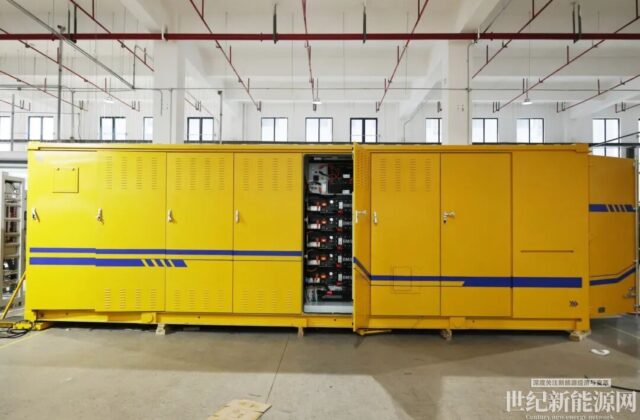
The article distinguishes AC- and DC-coupled solutions. Clear electrical connections, modular functions and standardised equipment make AC coupling useful for integrating different resources, grid support, balancing and emergency backup. At Trina's 300 MW Hanting rural-revitalisation PV demonstration base, the reported 120 MW / 240 MWh storage installation comprises 36 storage subunits rated at 3.354 MW / 6.708 MWh and 36 integrated 3.45 MW PCS-transformer units. Trina reports stable operation since grid connection, emphasising safety, life and electricity costs.
The article says DC coupling can use existing renewable-generation grid-connection equipment and connection routes, simplify architecture, reduce hardware investment and avoid conversion stages, improving overall efficiency. It identifies single-resource applications, microgrids and remote grids as relevant contexts.
The appropriate solution depends on the application's requirements. Trina emphasises complete system design and lifecycle services before, during and after delivery to support successful implementation and stable operation.
Flexible storage enclosures and coordinated controls
Trina's flexible battery-container design supports AC- and DC-coupled configurations. Its coordinated BMS, PCS and EMS monitor PV output, battery charging and discharging and load requirements in real time.
Algorithms analyse and forecast the data to optimise dispatch under changing conditions. Coordinating energy flows between PV and storage is intended to address grid fluctuations and load changes and support reliable supply.
For maintenance, the company describes an integrated digital-twin platform using connected sensing. Its plant-safety early-warning platform collects cell-level data at millisecond scale and evaluates voltage, temperature, state of charge, internal resistance and micro-short-circuit indicators. Trina claims seven-day advance warning and coverage of more than 80% of common safety risks.
Trina presents integrated PV and storage as a way to improve energy utilisation and support more intelligent and sustainable plants.
Continued development for new power systems
Drawing on decades of PV construction experience, Trina identifies technology iteration and coordination across pre-sales, delivery and after-sales work as central to project quality.
The company offers a unified customer interface to reduce redundant design and incompatible interfaces associated with multiple suppliers. It provides project-based engineering support from initial discussions to delivery and uses a global after-sales team for maintenance and warranty service intended to support safe and efficient operation.
Trina says its vertically integrated capabilities include storage cells, battery containers, PCS, residential storage and integrated energy-management systems. It presents this full-stack portfolio as supporting renewable-energy integration and the development of low-carbon power systems.
The company plans continued storage-technology and product development, combining product quality with lifecycle services to support energy-system transformation and customers' project requirements.