Projects
Longhua Guojiatun storage project positions two 165 MVA main transformers
The November 18, 2026 report dates transformer positioning to November 14 at the project's 220 kV substation. Accessory installation, electrical works, commissioning and grid-connection procedures remain subsequent tasks; this is not an operating storage-plant announcement.
On November 14, the Jiaotou Longhua Guojiatun independent energy-storage project reached a key construction milestone: two 165 MVA main transformers were successively positioned precisely and firmly secured at the project site in Guojiatun Town, Longhua County, Chengde, Hebei. This marked a phased achievement in installing the core electrical equipment of the project's 220 kV step-up substation, with work moving fully into installation of main-transformer accessories and electrical equipment throughout the station, laying a solid foundation for subsequent system commissioning and grid-connected operation.
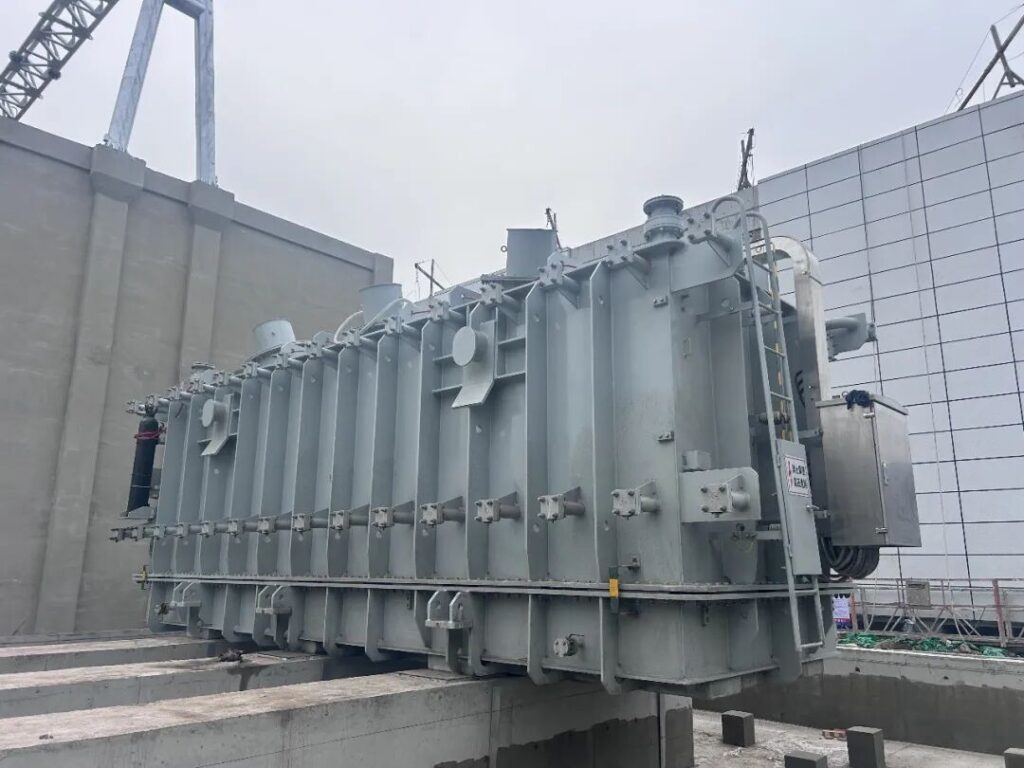
The main transformer is the central hub equipment of an independent storage plant's step-up substation, performing the key functions of stepping up voltage and efficiently transferring electricity in both directions between the storage system and the grid. It is large in size and heavy as an individual unit, with stringent positioning-accuracy requirements: horizontal deviation and positioning dimensions must be strictly controlled within the ranges permitted by national and industry specifications.
To ensure faultless transformer positioning, the project department joined the equipment manufacturer, construction contractor and supervision organisation in conducting a dedicated safety and technical briefing, reviewing and confirming key parameters one by one, including the load-bearing capacity of the transport route, foundation elevations and rail flatness. During the operation, a combined hydraulic translation and rail-pushing process was used, precisely controlling hydraulic-system pressure and pushing speed to achieve smooth, synchronised and accurate placement of the two main transformers. Technical and safety-management personnel supervised the entire operation on site, with every stage controlled and fully documented.
Since the project's launch, the EPC general-contracting team has maintained integrated planning across ‘design–procurement–construction–commissioning’, establishing mechanisms for coordinated progress across disciplines and organisations around full-cycle objectives. To address practical challenges including numerous equipment types, complex system interfaces, lengthy administrative-approval chains and multiple levels of grid-connection coordination, the Urban and Rural Construction Group established a dedicated new-energy task force. It proactively coordinated core matters including design drawings, equipment-production scheduling, compliance procedures and grid-connection coordination, ensuring implementation through task lists, milestones and closed-loop management.
Project construction has maintained Party-building leadership, with key Party members proactively identifying their roles and setting examples in critical areas including safety controls, quality acceptance, equipment coordination and administrative procedures. The principle that ‘safety is the bottom line, quality is life, and delivery is a commitment’ has been deeply integrated throughout construction.
Next, the project department will use transformer positioning as a new starting point to rapidly advance assembly of main-transformer accessories, vacuum oil filling and electrical handover tests. It will simultaneously install key distribution equipment including gas-insulated switchgear (GIS) and grounding transformers and lay cables throughout the station, while coordinating faster construction of the export line and modifications to the substation at the other end. It will also make every effort to advance procedures including the grid-connection application and approval for transition to commercial operation. Once completed and operating, the project will significantly improve peak-regulation and frequency-response capabilities and new-energy consumption in the northern Hebei grid, strengthen coordinated operation between independent storage and nearby wind and PV plants, and provide solid support for a green, low-carbon regional energy transition and high-quality development of a new-type power system.