Analysis & opinion
Sungrow signs Australian distribution agreements covering 4 GWh of storage and 1.5 GW of solar
Three distributor agreements include 1 GWh of C&I storage; the source analysis distinguishes channel commitments from future deliveries and the planned Hazelwood expansion.
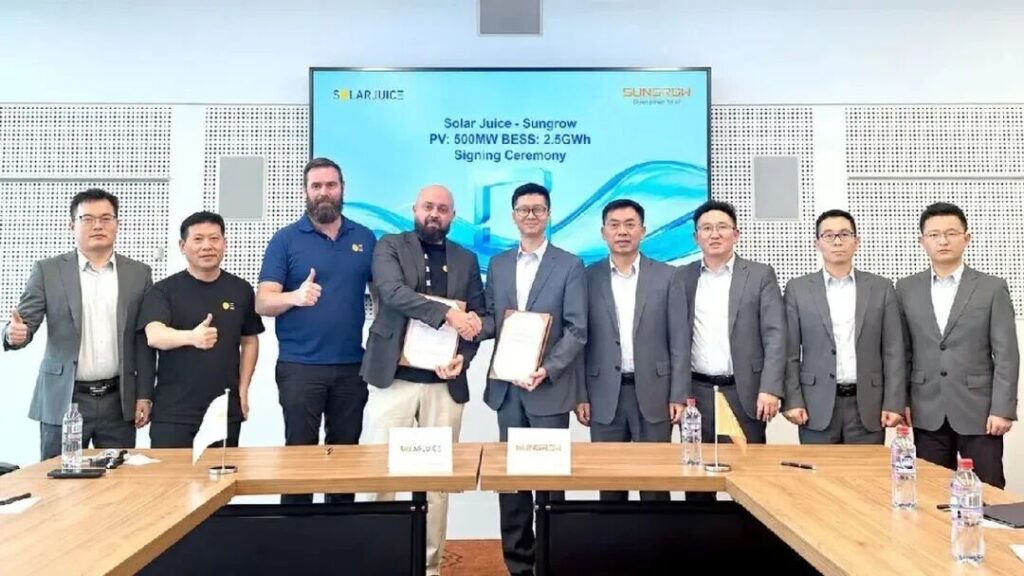
Australia's storage market is entering an unusually concentrated window of contract signings. Sungrow chose the annual All-Energy Australia exhibition to make a concerted push, formally signing distribution agreements in Melbourne on November 6, 2026 with three local Australian distributors — Solar Juice, Supply Partners and Raystech Group — covering a total of 4 GWh of battery energy storage systems (BESS) and 1.5 GW of photovoltaic projects. First disclosed by overseas media and then rapidly circulated within the industry, the news is widely seen as the largest systematic positioning move to date by a Chinese storage company in Australia's residential and commercial-and-industrial storage distribution channels.
The allocation of the three orders clearly reflects deeper changes in the structure of Australian storage demand:
Solar Juice secured the largest individual agreement: 2.5 GWh of storage systems + 500 MW of photovoltaics, with 2 GWh allocated to residential applications and 500 MWh to commercial and industrial (C&I) applications;
Supply Partners signed for 1 GWh of storage + 500 MW of photovoltaics, with residential and C&I storage accounting for 500 MWh each, a fifty-fifty split;
Raystech Group renewed and expanded its agreement for 500 MWh of residential storage + 500 MW of photovoltaics, continuing to increase its commitment on the basis of last year's cooperation.
The three agreements total 4 GWh. Residential storage remains the core market, but C&I storage's share has increased substantively. The combined C&I portions for Solar Juice and Supply Partners alone reach 1 GWh, no longer merely attached to residential-storage orders but becoming an independent growth driver.
As its distribution channels expand faster, Sungrow is also deepening its utility-scale project presence. The previously disclosed Hazelwood Battery Energy Storage System expansion in Victoria (HBESS 2), being advanced jointly by Sungrow, ENGIE and Elecnor, will receive a 150 MW/300 MWh storage system. The specific configuration includes 66 PowerTitan 2.0-series ST5015-UX storage units, 33 SC6900UD-MV PCS inverters and the EMS3000 energy-management system, with commercial operation targeted for 2028.
Sungrow has thus established a dual-track strategy in Australia: on the distribution side, it focuses on residential and C&I storage and strengthens channel throughput; on the utility side, it uses PowerTitan 2.0 as its technical benchmark and anchors itself in grid-scale project standards. The two paths are not separate, but together build localised service capabilities covering all application scenarios.
Viewed over a longer period, the 4 GWh signing is not an isolated event. Sungrow entered the Australian market more than a decade ago and has cumulatively delivered over 400,000 photovoltaic and storage systems, with its channel network fully covering residential, commercial and utility applications. Raystech's agreement continues cooperation from last year, and Solar Juice and Supply Partners are also expansions of existing channels rather than first-time partnerships. This shows that the orders fundamentally amplify capacity within existing channel relationships rather than acquire customers from scratch. As Australian storage tendering and distribution competition heat up together, the ‘established channels, new scale’ approach reflects a company's depth of regional market penetration more accurately than a single breakthrough.
The timing logic behind these orders deserves even closer attention. Australia's federal and state governments are raising storage-installation targets in quick succession. New South Wales has substantially increased its 2030 storage target to 56 GWh, while a significant gap remains between that target and the scale of projects currently contracted and delivered.
Demand is also undergoing a structural shift: on the residential side, Australia has long ranked among the global leaders in rooftop-solar penetration, and storage is rapidly evolving from an ‘optional accessory’ into an infrastructure-level component of household energy management; on the C&I side, increasing electricity-price volatility and demand-management pressure are pushing C&I storage from demonstration applications into batch deployment.
By committing to both residential and C&I markets through 4 GWh of distribution orders, Sungrow is essentially betting that Australian storage demand is spreading faster from a residential-only market into a three-tier structure of ‘residential + C&I + grid-scale’. If that pace materialises as expected, early scale in distribution channels will naturally become an access advantage for subsequent project implementation, system integration and long-term operation-and-maintenance services. If the pace comes under temporary pressure, the flexibility of distribution can also effectively share inventory risk with local partners rather than concentrate all of it at the manufacturer.
The overall figure of 4 GWh is striking, but what warrants deeper industry consideration is the structural division behind it: residential storage remains the core market, but is no longer the sole focus; C&I storage is moving from a supporting role to a leading one; and utility-scale projects are simultaneously establishing reference points for technical standards and system integration.
Sungrow's latest move in Australia is less a harvest of orders than a systematic advance positioning of channels, products and benchmark projects, establishing capabilities across all application scenarios ahead of a key transition from a single-tier to a multi-tier market. The next key points to watch are the actual pace of deliveries under the three distribution agreements in 2027, and whether, after Hazelwood 2 connects to the grid, PowerTitan 2.0's technical reputation in Australian grid-scale projects can feed back into and further improve conversion efficiency within C&I storage channels.